
With over 30 years of engineering experience, Neil joined JNP Group in 1999. He has undertaken a number of roles and leads on large, complex, multi-disciplinary projects.
When did you first become aware of the possibility of a career in engineering?
My favourite subjects at school were physics and maths. As a natural problem solver with an interest in historic and new buildings, engineering was the perfect fit for my inherent skill set and interests.
What inspires you about engineering?
Engineering is one of the most important aspects of our modern world. Structural engineering in conjunction with other professional disciplines has worked with the environment to shape where and how we live, play and rest. Without structural engineering, buildings wouldn’t be as tall, strong, or as aesthetically pleasing, and our landscape wouldn’t be anywhere near as interesting, modern, technologically advanced, or as comfortable to live and work in.
What does the future of structural engineering look like?
There’s no doubt that the industry has changed and evolved massively, but it’s hard to see the definition of a structural engineer changing too much as our services are always going to be needed, that is unless the laws of physics can be altered.
We will still be responsible for designing structures, considering the intended use, maintenance and demolition. Using fundamental and basic engineering principles for bespoke solutions is required, to be able to do that takes continuous training, “Every day is a school day”. A prospective structural engineer needs to study hard and learn from the skills mastered by their predecessors, keeping up to date with advances in technology and construction techniques.
Ever-advancing technology is a big factor to consider in the coming years, with repetitive tasks that take up a lot of engineers’ time now gradually becoming more and more automated. Artificial intelligence does not replace wisdom and experience; there is no substitute for validation by hand using simple calculations from first principles.
As designs become more and more complex and architects grow more ambitious, structural engineers will be increasingly challenged. This is where our expanded knowledge and cooperation with other fields will come in. What would have seemed like impossible feats ten years previously will become reality.
Anything you would like to share with aspiring engineers that are considering joining the industry?
Structural engineers who are just starting out on their career journey can look forward to a future full of exciting developments, there’s never been a better time to be a structural engineer. It’s a sector that’s on the brink of massive development, and the job itself is set to evolve into something that encompasses so much more than the traditional concepts of structural design. As our buildings get taller and our needs change, structural engineering will step up and show us all what great design and innovative thinking can do.
What is your favourite structure and why?
There are too many to mention as I find interest and fascination in all kinds of structures, I particularly enjoy city centres as they contain both historic and modern structures. I find myself tripping up and bumping into things when walking around city centres, as my eyes are always drawn up to take in the whole structure that is alongside me.
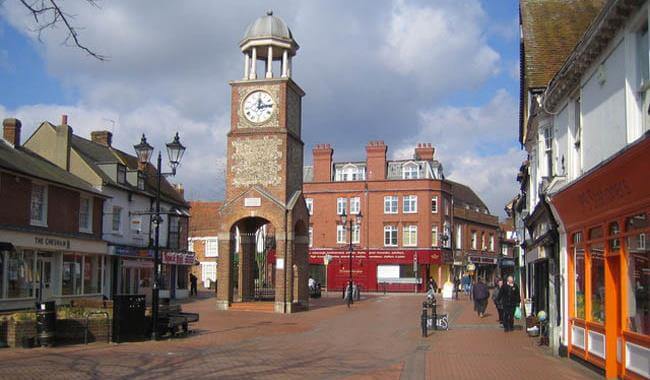
Chesham town centre. Photo Credit: Visit South East England