With over 20 years’ experience Rodrigo heads up the Flood risk department, responsible for designing water management infrastructure, preparing flood risk assessments and drainage strategies in compliance with national and local planning policies.
When did you first become aware of the possibility of a career in engineering?
Engineering is in my DNA. I come from a line of engineers, starting with my grandfather, who, despite having no formal training, possessed a natural gift for problem-solving. He was the go-to person for fixing or building just about anything. His talent and passion inspired both my father and brother to pursue careers as mechanical engineers. With that kind of legacy, it was inevitable that I’d follow the same path.
Why did you choose Civil Engineering as a career path?
I got into civil engineering as this felt like the best fit for me. I studied for my Civil Engineering degree back in my homeland of Portugal, finding the hydrology and hydraulics modules the most interesting, leading to me specialising in water engineering. I am fascinated by water, the power, the movement, it’s effect on the land as well as the impact it has on everything that we do. After finishing my degree, I became a member of “Ordem dos Engenheiros”, the Portuguese equivalent to ICE and CIWEM. I relocated to the UK to pursue a career with a global consultancy dedicated to sustainable development. It was a great learning experience, but I came to learn that muti-national companies are not for me and that I am much more comfortable working for smaller consultancies, where the work feels more hands-on and collaborative.
What inspires you about Engineering?
I like the idea that through our designs we are reshaping the world, hopefully for the better. Through our work we are given a chance to make the necessary developments safe for generations to come and creating them in the most sustainable way possible.
Whether it’s improving infrastructure, protecting communities from the impacts of climate change, or designing with sustainability in mind, engineering gives us the tools to make a real difference.
What has been your favourite project that you have worked on?
At the start of my career, back in the glorious nation of Portugal, I worked on a large regional development plan known as Alqueva Multipurpose Project. The major regional development plan focused on the construction of five dams, reservoirs and a hydroelectric power station with the aim of supplying water for around 200,000 people, support agriculture and industry and generate clean energy for the region.
I was involved with designing several key elements including dams, hydro-power plants, canals and irrigation networks. It was incredibly rewarding to contribute to a project that aimed to transform one of Europe’s most disadvantaged regions into a more economically and socially viable area.
What is your favourite structure and why?
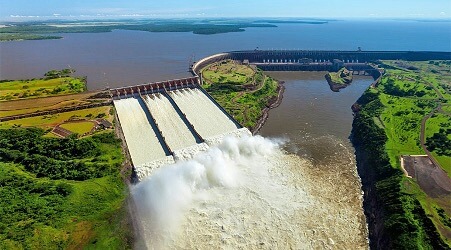
Being a water engineer I am fascinated by dams, their sheer scale and the complexity involved in designing a structure that can harness the power of the water to create power in a sustainable way. The Itaipu dam on the Bazil Paraguay boarder is the most impressive manmade structure I’ve ever visited. It is almost 8km long and is one of the world’s largest producers of hydroelectricity, a true feat of engineering.
On a much smaller scale, the Pisao and Roxo dams, part of the Alqueva Multipurpose Project mentioned above, are the most impressive structures I ever contributed to as an engineer. Being involved in their design and then seeing those designs come to life gave me a real sense of achievement. It is incredibly rewarding knowing that you have contributed to making a difference to the environment and the surrounding communities.